Exhortative Message: The Journey of Growth

美佳之窗 His Window 110( Apr - Jun 2025 )主流话题
Text by Rev. Matthew
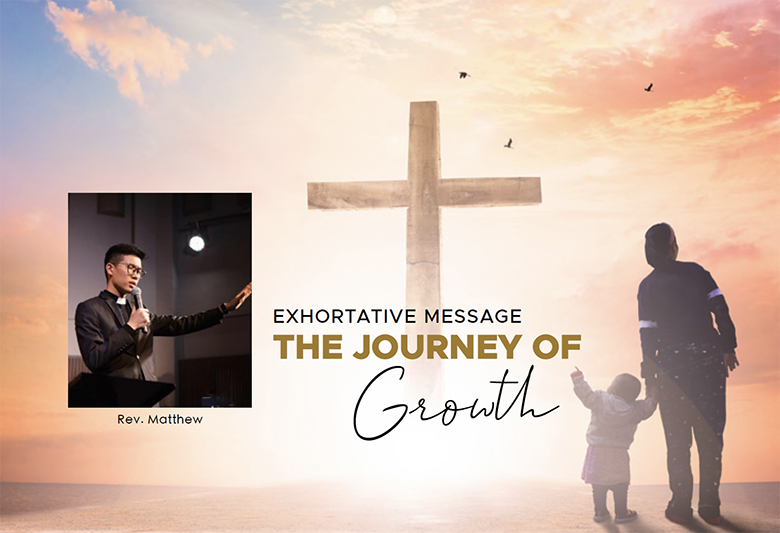
A Christian’s journey is very much likened to that of a child. When the child is born, he or she embarks on this amazing journey of growth from baby to toddler, toddler to teen, and finally an adult. The journey to adulthood is a mix of joys and pains in the process. But how the child grows, what is being input to the child determines the outcome of growth. The Christian life is like that as well. What you input and the effort put into spiritual growth determines the spiritual health and maturity of the believer. The Bible clearly emphasizes on the importance of Christian growth in life. Paul, in his many epistles to the church, speaks on how the Christian must progress in life, using metaphors such as “milk to meat” to demonstrate his point of growth. However, the elephant in the room is always the question on how can we measure spiritual growth? Unlike a baby, where the growth happens naturally, spiritual growth is hardly seen let alone measurable. So, how can we grow as a believer? What are some practical steps the Christian can take to ensure we are on the right track of spiritual maturity? Let us go to the scripture to form the framework for effective and evidential spiritual growth.
1. Lay the Foundation
The foundation for spiritual growth is important. A baby needs a good balance of formula in order to grow healthy and strong. A good formula milk gives, enhances and provides the necessary nutrients for the growth and development of the baby. Likewise, a Christian needs to lay down a good foundation of faith in order to grow healthily in the faith. In 1 Corinthians 3:2, Paul writes on how he fed the Corinthian believers “milk, not solid food.” Paul was demonstrating to the Corinthian church that he did not neglect laying the foundation of their faith. The foundation of faith that Paul laid in the Corinthian church was a foundation of solid biblical teaching and spiritual disciplines. By stating that they were not ready for “solid food” he was informing the Christians that the more advanced theologies or doctrines of the Christian faith was not something he taught them yet, for it was secondary and they were not spiritually able to digest the deeper truths and mysteries of the faith. However, now as he wrote to them, he expresses his disappointment in verse 2 when he writes, “...you are still not ready.” And then he further elaborates, “You are still worldly. For since there is jealousy and quarrelling among you, are you not worldly?”
The Christians in Corinth somehow have not progressed as expected and one of the key indicators – their worldly behaviours. Here we get a hint that laying a good foundation in a Christian’s life is not just the input of biblical knowledge. It is also the practice of the basic truths learned and applying it to life. It is about driving the worldliness out of you, and allowing Christ-likeness to take root. It is about driving out sinfulness and allowing holiness to take root. The Corinthian Christians had been input with foundational truths, yet failed to live according to the truths imparted. They were still “worldly” or, in other words, sinful in their practices. Some “worldly” practices Paul highlighted were jealousy, quarrelling, and division (3:3-4). Ponder for a moment, if Paul’s statement in 1 Corinthians 3:2 is fitting to our state of being now? Are we still “not ready” meaning to say, there is no clear indicator of spiritual growth in us. Our attendance in church may be perfect, our Bible-reading as well, but these spiritual inputs or actions somehow are not translated into our daily lives. There is no change from our old ways, we are still drawn to sin, and we fail to live according to God’s biblical standards. What are we going to do to right the course we are currently on right now? Are we willing to start practising the basic principles of faith and lay a good foundation for our spiritual life to be built on?

2. The Right Building Materials
As Paul progresses on, he speaks on how the Christian should “build with care (v. 10).” He lists down a list of materials that serve as a metaphor for building your spiritual life. Some materials listed are rather exaggerated such as, “gold or silver and costly stones.” These are maybe found in palaces or homes of the rich. Some other materials such as “wood” are common in the building world and it creates a strong building that can generally withstand the natural elements. However, Paul also lists down some lightweight materials like “hay or straw” which are never really known for it’s sturdiness. It may be easier and faster to build with lightweight materials, but these materials have no capability to withstand stronger winds, let alone storms. It will collapse almost as quickly as it was built!
Paul uses this metaphor to explain that the kind of building built on the foundation determines if your spiritual life makes or breaks when faced with the challenges of life. The purpose of a building is to provide protection and shelter from the natural elements. Similarly, what we build on our spiritual foundation provides us protection from spiritual storms and challenges. Are we going to put in the effort to go deeper in the Word of God? Are we going to grow roots that go deep and wide in truth? Are we going to build up our faith and trust in Jesus? As we progress in faith, do we continue to use the Word of God as our guide and build “material” or will we stray away and resort to worldly philosophies for our “building material”? It is important to ask ourselves this important question: am I building a building that is secure, with proper building materials? Am I building upon the spiritual foundation with the utmost care?

3. The Right Attitudes
Finally, Paul teaches the Christians two valuable lessons on the right Christian attitudes that encourage greater spiritual growth. First, Paul writes that the Christian is “God’s temple and God’s Spirit dwells in their midst (3:16).” Paul was reminding the Christians to cultivate a sensitivity towards God’s presence in their lives. This attitude can help the Christian to be in tune with the Spirit, to recognise God’s voice, and to be corrected through conviction. The Christian must be increasingly sensitive as time goes by, so that God’s voice will not be drowned out by the noise of the world around them. The Christian must be sensitive to God’s leading so that the ways of the world will not cloud the path of righteousness. The Christian must be increasingly sensitive so that truth will always prevail instead of lies.
Secondly, Paul also teaches the Christians that they must remain humble. In verse 18, he writes, “Do not deceive yourselves. If any of you think you are wise by the standards of this age, you should become ‘fools’ so that you may become wise.” As time goes by, one must grow in humility. As the Christian knows more about the faith, he or she must practise even greater humility, lest pride causes the downfall. A humble heart is one who never looks at oneself as having all wisdom. A humble heart acknowledges that there is much room for growth. A humble heart does not reject teaching given, it welcomes teaching, knowing that it is for their good. A humble heart never boasts in his or her accomplishments, rather acknowledges that everything is possible only because God is in control. The key to continued spiritual growth is humility.
Ponder on the closing 2 attitudes Paul encourages all Christians to have. Are we still sensitive to God’s voice in us? Are we open to the work of the Holy Spirit in us? Are we walking in humility towards God and men?


